
If your technology services company has hit a growth ceiling, you are not alone. For many business leaders, word-of-mouth networks and scattered marketing tactics have historically provided just enough traction to keep the lights on.
However, relying on a fragile pipeline means you never truly know where your next high-quality lead is coming from. This uncertainty leaves your revenue stagnant while your leadership team remains chronically overstretched. To break through, tech firms must embrace the “pistachio ice cream” metaphor, which illustrates how the federal government perceives itself as an entirely unique entity. Because the government sees itself this way, it is critical to tailor your website and content specifically for federal buyers to avoid being filtered out as a generic commercial vendor.
At Witmer Group, we help B2B and tech service organizations step out of this exhausting juggling act. By building customized marketing strategies, targeted content, and resilient operational processes, we transform your digital footprint to attract high-quality buyers consistently, enabling sustainable growth while you reclaim your zone of genius.
Transitioning your tech company’s pipeline into new, highly profitable markets is a primary driver of long-term sustainability. One of the most lucrative—yet notoriously misunderstood—landscapes for tech services is the federal sector.
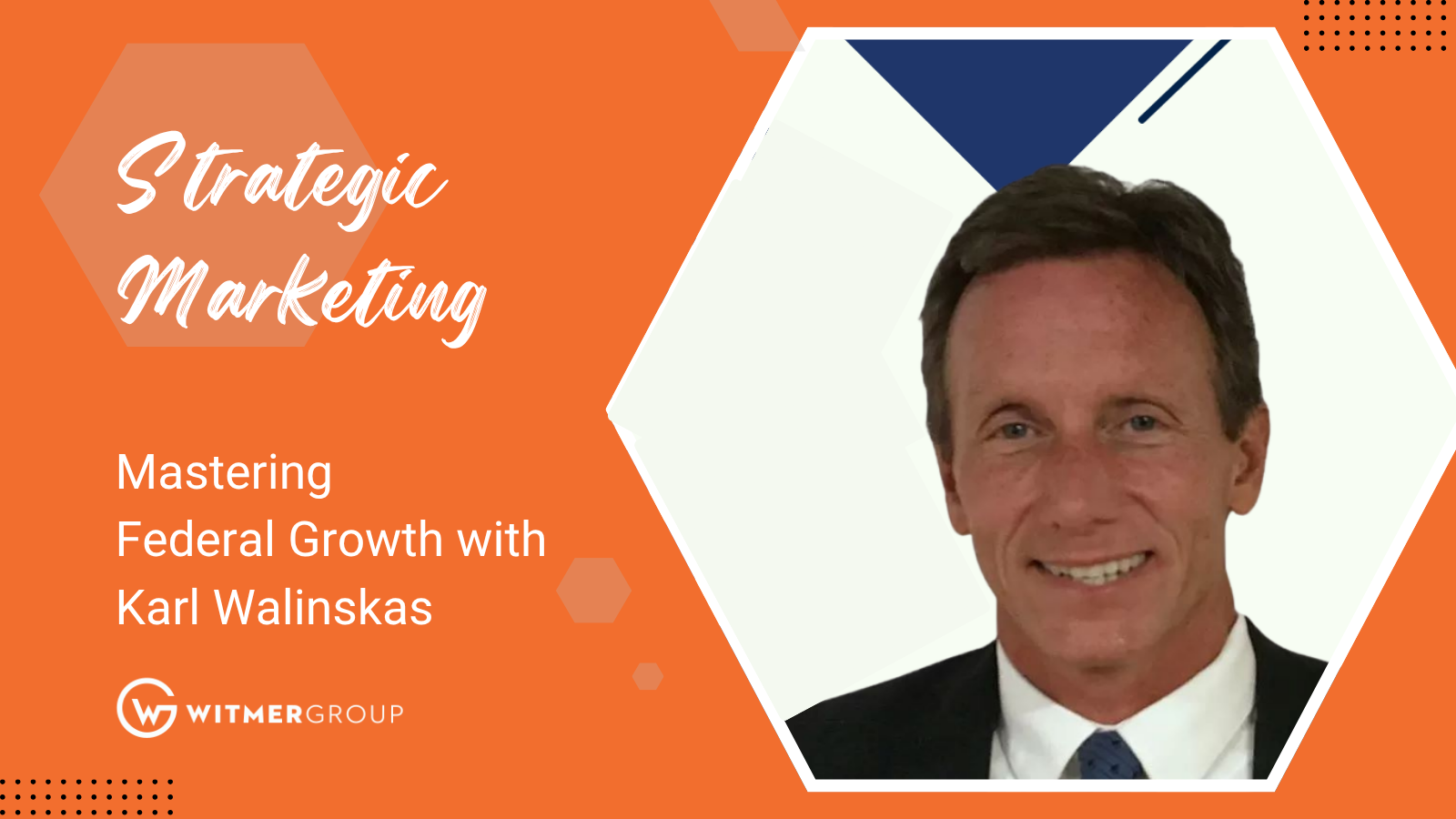
On a recent episode of our live broadcast, Ready, Set, Action, I sat down with Karl Walinskas, the CEO of Fedtrax and an elite business development specialist in the federal market. Karl helps innovative firms specializing in AI, machine learning, cybersecurity, and data analytics bridge the gap between commercial success and government revenue.
Karl highlighted a vital reality for B2B tech executives: The federal government is a massive buyer, but they think they are pistachio ice cream—entirely unique and unlike anyone else. If you approach them looking like a generic commercial vendor, they will filter you out of the room instantly.
1. The Website Imperative: Creating a Dedicated Gateway
Many commercial technology leaders make the mistake of thinking their existing website is sufficient to attract government procurement officers or prime contractors. It isn’t. When a federal program manager or agency director reviews your digital presence, they are looking for precise evidence that you understand their mission-critical objectives.
At an absolute minimum, you must construct a dedicated federal or government services landing page.
[Your Website Homepage]
       │
       ├──► Commercial Services / Industries
       │
       └──► Government Services (Dedicated Mission-Focused Hub)
                ├── Core Capabilities (AI, Cyber, Data)
                ├── Past Performance Matrix
                └── Capabilities Statement (Downloadable One-Sheet)
If your commercial branding is highly casual or tailored strictly to corporate finance, logistics, or retail, you may even want to consider launching a distinct microsite dedicated solely to government operations. This allows you to adopt a precise tone that reflects the compliance and structural language of public agencies without diluting your commercial brand.
2. The One-Sheet Capabilities Statement: The Coin of the Realm
In the federal ecosystem, the fundamental currency of communication is the “one-sheet” or Capabilities Statement. When you interface with federal decision-makers or prime contractors looking for socio-economic sub-contracting partners, they will ask for this document immediately.
A high-performing Capabilities Statement is a dense, precisely structured PDF that acts as a blueprint of your operational viability. To get your foot in the door, your one-sheet must explicitly feature:
- Core Competencies: A concise breakdown of your technical solutions, framed around how they solve specific agency challenges rather than abstract commercial benefits.
- Differentiators: What makes your delivery infrastructure unique? (Note: Avoid using generic claims like “we have great people” or “superior quality.” Unless you possess a third-party credentialed asset—such as a Nobel laureate or a Malcolm Baldrige Quality Award—quality is considered a baseline requirement, not a competitive differentiator).
- Corporate Data: Your UEI (Unique Entity ID), CAGE Code, NAICS codes, and any explicit socio-economic certifications (e.g., SDVOSB, HUBZone, WOSB).
- Past Performance: A referenceable track record of your work. If you are transitioning from the commercial sector, highlight complex enterprise implementations that mirror the scale, security, and data integrity required by public agencies.
3. Designing for the Three Pillars of Federal Procurement
A comprehensive federal B2B marketing strategy cannot speak to an agency as a single monolith. Your messaging, content assets, and technical documentation must satisfy three entirely distinct internal buyers, each looking for different risk mitigation metrics:
| Stakeholder Pillar | Primary Operational Focus | What Your Content Must Deliver |
| The Executive/Agency Leader | Strategic ROI, long-term institutional stability, and macro mission success. | Proof of a 3% to 5% gain in operational efficiency or multi-million dollar long-term budgetary savings. |
| The Registrar/Program Manager | Tactical execution, eliminating administrative overhead, and reducing implementation friction. | Case studies showing a repeatable project plan and how you pivot staff from clerical labor to professional verification. |
| The CISO / Technology Office | Data integrity, absolute security compliance, and fraud mitigation. | Strict validation of accuracy rates (e.g., 95%+ data extraction metrics) and bulletproof adherence to FERPA or FISMA frameworks. |
4. Dodging the “AI Proposal Trap”
With the explosion of generative AI platforms like ChatGPT and Claude, the administrative burden of responding to Requests for Information (RFIs) and Requests for Proposals (RFPs) has dropped dramatically. However, this has created a dangerous double-edged sword for small and mid-sized tech firms.
Because generating text has become easier, federal procurement offices are seeing an unprecedented influx of generic, automated proposals. Agencies are responding by deploying their own AI screening tools to audit and discard low-effort, templated submissions out of hand.
To maintain a resilient pipeline, your growth strategy must focus on pre-RFP shaping. The goal of your marketing and business development alignment should be establishing customer intimacy long before a formal solicitation is published. By positioning your thought leadership, scheduling early briefings with program managers, and offering innovative solutions to their upcoming challenges, you ensure that when your proposal arrives, it is read by human eyes rather than filtered out by an automated algorithm.
Building a Predictable Path Forward
Transitioning into the federal market requires deliberate resource allocation. Given that public procurement cycles can range from six months to two years, tech companies must keep their current commercial operations completely optimized to fund this long-term expansion.
You do not have to navigate these complex, shifting operational landscapes alone. Connecting your tech company with the clients who need your expertise most is exactly why we exist. We build the infrastructure, the targeted messaging platforms, and the sales enablement systems needed to stabilize your current pipeline and confidently capture your next chapter of business growth.
Are you ready to stop managing a scattered marketing engine and start scaling predictably?
Let’s connect today to discuss how we can build a managed marketing execution plan that positions your organization as a dominant player in both commercial and federal arenas.